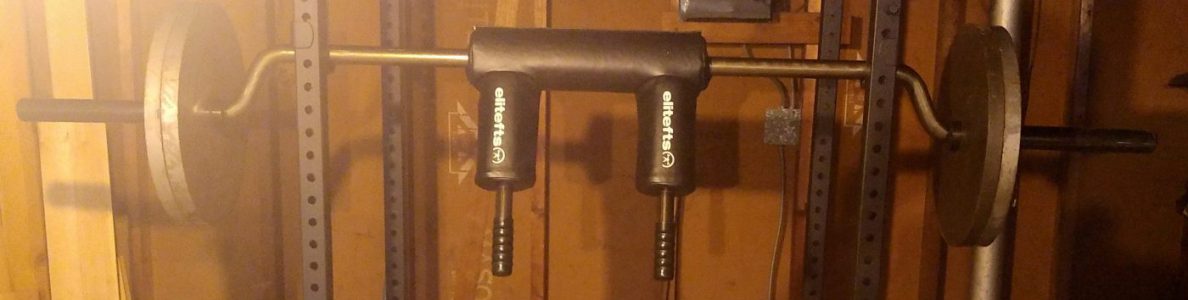
After much screwing around with various training templates/programs, and really trying to figure out what fits just right into my training week (and my normal life week), I finally wrote something down that I think will work pretty well. I tested it out for 1 full 6-week cycle, and I think I’ve got a pretty good handle on how I want to program moving forward.
Well, let me back up a little bit and give a little color to what I’m trying to do. I’ve been lifting weights for a long time, but my background is more in endurance sport with a history of competitive swimming. After highschool, and through college, swimming fell away and martial arts took over. I focused on competing in karate at this time, but I was still consistently lifting each week. Years ticked by, and running entered my life. I loved running. I loved the freedom of moving my body through space and trying to get my body to do it as efficiently as possible.
In 2009, I attempted my first marathon. I was somewhat undertrained, having only logged 1 long run of 18 miles in preparation, but I figured I was signed up so I might as well give it a go anyway. Twenty miles in, and my legs started cramping up, by mile 21 I had to sit down and weight for the race’s emergency vehicle to swing by and ride back to the start. Not exactly my proudest moment, but it is what it is. I knew I wanted to get back and run the marathon again at some point, but this is where lifting really started to take over.
Anyway, flash forward to 2020 and the pandemic started. I was working from home which was great for trying to lift consistently, but it also meant that I was spending 12 hours per day staring at a computer screen, and the only sunlight I saw was the reflection of the sun off of my computer monitor coming from the window behind me. I realized that I needed to simply get outside and get fresh air, so I bought a new pair of running shoes and got back on the roads. Around this time was when I re-read the book Ultramarathon Man, by Dean Karnazes. I’ve read this book more times than I an remember and each time it’s gotten me amped up to start running again, but this time I think it’s really sticking. After running consistently for a few months, I signed up for a marathon in April 2021.
Over the last few years, I’ve had a habit of picking up training books that I’ve heard about, one that I grabbed was called The Hybrid Athlete by Alex Viada. I’ve talked about him in a previous post, but bottom line the man is inhumanly strong and has incredible levels of endurance. Plus, he trains others to do the same thing.
I’m using his training templates as guidelines on how to progress my own training moving forward, and I think I’ve finally made a bit of a breakthrough, in terms of setting up my programming. I’m going to include the general layout below, and in subsequent posts I’ll outline how I programmed the first Cycle and the problems I think I made and how I’m fixing them for the second cycle.
Program Structure:
- Day 1: Upper Strength – this day is a combination of force production (heavy work) and rate of force production (speed work), with a heavy.
- Day 2: Lower Strength and Tempo Run – another combination of heavy and speed work on this day, coupled with a run. Ideally, I would want the run to happen earlier in the day as this is my priority, but it really doesn’t matter much as there’s sufficient amount of time in between to allow for enough recovery to keep one workout from interfering too severely with the other.
- Day 3: Recovery Run – just a shake out run, get some bloodflow through the lower body after the beating it got the day before. This can be done on the AirDyne or bike as well, the idea is simply to move at a low intensity.
- Day 4: Upper Hypertrophy – volume and intensity is the name of the game here. Muscle loss is a pretty significant concern in this type of program, so hypertrophy training is emphasized.
- Day 5: Lower Hypertrophy and Tempo Run – as above, volume and intensity is key here as hypertrophy stimulus is important to maintain muscle mass on this kind of a program.
- Day 6: Long Run – depending on the type of race being trained for, this can go anywhere from 1 hour up to 6 hours (or longer if training for an exceptionally long race). As I’m training specifically for a marathon, I’m looking at 1-3 hour runs primarily.
- Day 7: Rest or Recovery Run – as above, just getting blood flowing. If/when I’m training for an ultramarathon, this will become a secondary long run every 3 or 4 weeks to have back-to-back long runs.
So there it is, the general program structure. On the strength days, volume is relatively low and intensity is relatively high, for the express purpose of pushing maximal strength. On the hypertrophy days, the volume is increased fairly significantly, and intensity is moderated. Sets are controlled based on RPE, with the RPE being waved upward each week, and resetting mid-cycle. I’ll talk about this more as I get into cycle specifics.
Anyway, this is a fair amount of work, and it might look like it will be counterintuitive, but seeing as I’ve completed the first cycle, I have a pretty good idea of what is and isn’t working. The main point here is the consolidation of stressors, and maximizing rest time as much as possible. With the above program structure, my lower body days are particularly intense, but upper body days provide full lower body recovery, and Sunday is either another light/easy run, or it’s a day completely off.
 Ramble on Fitness