How many workouts can I get in this year? Ideally, I’d love to say that I’ll get a minimum total of 365 if I combine lifting, running and BJJ. Let’s see what happens and I’ll tally up at the end of each week! (Week 1 is starting from 1/1/19 and as such, it won’t be a normal Monday-Sunday/Sunday-Saturday week).
Category: Blog Post
Approaching Competition with a Sub-Par Training Cycle
At the beginning of the year, I signed up with Garrett Blevins’ on-line AI-based training program, and frankly, I loved it! I had signed up when I was well over 30 weeks out and had ample time to let the off-season portion of the training really work its magic and build me up. And boy did it ever!
Over the course of 3, 4-week training blocks, I managed to hit a 395 squat, which is the heaviest I’ve ever successfully squatted; a messy 275 bench and a comfortable 455 deadlift. These numbers are nothing particularly impressive, but given that I was working on cutting my weight down to 180lbs from 195lbs, and this was a program where the AI recommended to be in a surplus, or at least maintenance calories, I was pretty damn happy.
The problem is that I let the wheels fall off with regards to my rest and recovery. Along with the progress on my lifts, I also managed to reaggravate a shoulder injury from last year, as well as painfully pull my left TFL. These 2 injuries prevented me from lifting for a good while and I ended up removing myself from the program as I was unable to follow it. Now, this is not to say that any of the injuries were a result of the programming. The programming was fantastic and was very well designed, however, it was based on very high frequency and volume where I was squatting and deadlifting 3 times per week, and benching 5 times over the course of only a 3 day training week. You can see how the intensity would really build up.
So, once all was said and done, I was fairly certain that I was down for the count as I couldn’t squat at all for several weeks, and considered pulling out of the meet. But, I was able to pull it together and get myself back on a somewhat successful training program structured around a conjugate-style of training. My weights aren’t nearly anywhere close to what I was hitting with the higher frequency program, but between physical therapy and a greater degree of fatigue management through the new program, I feel more optimistic about actually competing.
As of this writing, I’m 2 weeks out from the meet, and frankly I just want it to be over. I’ve had little motivation to train of late, and I think it’s just been stressful managing my diet. I opted to stop trying to cut and just let myself lift at the heavier weight class. I still have a goal of cutting down to 180 (just to prove to myself that I can), but I’ll allow myself post-meet off-season to work on that.
Anyway, how am I approaching this meet now? Well, given the struggles that I’ve had (all in addition to personal life changes that have also been occurring), I’m looking at it as an opportunity to finish something that I started. Even if I just maintain my weight, I’ll still be going in lifting 10lbs lighter than I did 3 years ago, so that’s still progress in my book. Additionally, my lifts are close to the numbers I hit at a heavier body weight, which is also progress. At the end of the day, I just want to go in and have fun with it. I’m competing with a close friend and that’s the important thing right now.
Competition can be stressful on its own, don’t forget to have fun and be playful with it.
New Years Resolutions
I hate New Years Resolutions, I think for the vast majority of society they’re an opportunity for nothing more than verbal/mental masturbation. Now don’t get me wrong, resolution-ing is largely a subset of goal setting, and I’m all for goal setting – in fact, it’s absolutely necessary to have goals in your life so you have markers for progress as well as key performance indicators (KPIs) that help you gauge whether you’re on the right track or not.
The problem tends to be that most people have very vague resolutions. For example:
- I’m going to lose weight this year.
- I’m going to do better in school.
- I’m going to get my dream job.
- I’m going to go to the gym.
What do all of these statements have in common? Well, as I said before, they’re all very vague, each statement can be interpreted in many different ways for each person that hears it. If we take the first statement “I’m going to lose weight this year” that could mean anything from a quarter of a pound to 50 lbs depending on the person. There’s no target, and there’s a lot of wiggle room to allow a person to sustain a bear minimum of change (if any is really necessary) to feel good about achieving their goal.
Now, if you were to take that statement and apply SMART goal setting principles, you’ll be in better shape. What are SMART goals, you ask? Well, I’m glad you asked that! Here’s a brief breakdown:
SMART goal criteria first appeared in an issue of Management Review in 1981 in a paper written by George T. Doran (a former Director of Corporate Planning for Washington Water Company) titled There’s a S.M.A.R.T. way to write management’s goals and objectives. In this paper, Mr. Doran indicated that for management to be most efficient and effective in its goal setting, the goals should follow a very simple system, which he named with the acronym SMART. The acronym stands for:
- S – Specific
- M – Measurable
- A – Assignable
- R – Realistic
- T – Time-related
There are other variations that have been written of the SMART system over the years, but by and large, the purpose and the meaning has generally stayed the same. When applied to a business environment it’s very obvious to see how this process is helpful, but how does it help a person in their daily life?
Well, let’s go back to the “lose weight” goal, shall we?
If we want to follow the SMART principles, let’s determine what a SMART version of the lose weight goal would be.
- General resolution: I’m going to lose weight this year.
- Specific: I’m going to lose X pounds this year.
- Measurable: I’m going to lose X pounds this year.
- Assignable: I’m going to lose X pounds this year
- Realistic: I’m going to lose X pounds this year from starting point Y.
- Time-related: I’m going to lose X pounds this year from starting point Y.
Obviously, the statement of the goal doesn’t have to change much to apply to the SMART principles, but as you can see it’s easy enough to do. The point of this exercise is to create a measurable and trackable goal that you are specifically held accountable to. It’s easy to take a little change as a big win, when you could make a big change with a little extra effort.
Let’s take this and apply it all to my goals:
I currently weigh 190lbs and I will cut down to 175lbs by mid-year (June 30th) and then gain weight back to 185lbs by year-end (December 31st) with minimal change in body fat composition.
Now, I’ve created a specific goal with specific parameters, I’m now accountable to these markers throughout the year. The goal is measurable, I know exactly what weights I want to be at and at specific time periods. The goal is assignable, obviously, this is a goal for me. The goal is realistic, I established my starting point (190lbs) and I’ve set an ultimate goal of losing 15lbs in 6 months (that’s 2.5lbs per month), followed by 10lbs of weight gain in the subsequent 6 months (1.7lbs per month). Plus, I’ve set a further specific parameter for the second-half goal of maintaining my body fat composition (here’s the one area that’s hard to specific with, I’m going to be using qualitative measurements as opposed to quantitative due to the lack of availability of suitable measuring apparatuses). Lastly, the goal is time-related, I’ve set very specific hard deadlines for each step which will allow me to develop KPIs along the way.
I hope that helps any of my readers to better plan out their year, months and days of 2018!
Bonus Resolution: I’ve set the goal for myself to publish 1 article every week, it doesn’t matter if I write a bunch of them earlier and set them to publish later on, or if I literally sit down every week to write a new one, I’m going to write 1 article every week. Anything over that is just gravy.
Doing Stupid Stuff
It makes me sad when I can’t find the time, and/or the motivation to train. Sometimes, you just need to do something stupid to get your ass back in gear…so I decided on the following stupidity. There was an article on T-Nation by Charles Staley where he describes a protocol he likes using to help clients break through plateaus – this protocol is called Stack-10. The idea is to work up from an empty bar with sets of 10, using jumps of 10% of your 1RM for each set.
Coach Staley does specify that this protocol should only be used for 1 lift at a time, and only once per week so that you allow for ample recovery, and performing a 2nd workout with the same lift in a more strength focused format (lower reps, higher intensity). Here’s where the stupidity comes into the picture: I’m going to be using this protocol but anywhere 3-4 times per week for the same movement pattern. My squatting is garbage, and it never seems to make the progress that I want, and sometimes doing stupid things is an absolute necessity to make progress.
My plan is to take every squat variation that I can think of and apply the Stack-10 protocol. The caveat is that I’m going to use my low bar, competition squat max as my measure of weight jumps regardless of the variation. I’m going to use an estimated max of 315, which means for each lift I’m making 30 lbs jumps for each exercise.
The purpose in all this is going to be greasing the groove of the squat patterns and really train up my back to maintain position. So regardless of the movement, I’m going to be using a high volume of warm-up sets to focus on the greasing of the groove: 2 or 3 sets with the empty bar, and start working up from there.
After the squatting, I can do whatever I really want, there’s nothing set in stone, but I’m thinking that hitting some kind of pressing movement would be a good idea. So I might try a similar protocol with a wide variety of pressing variations from seated OHP to decline bench press. I’m not sure what I’m going to be doing for upper body, but ultimately the volume should cause a huge stimulus in my body to cause hypertrophy and fat loss.
Week 1 I’m going to go with low bar squat, then front squat and then Zercher squats. After this week is done, I’m going to start looking at other variations involving bar placement as well as the addition of bands, and even paused reps. It’s all about variety within a movement pattern to cause a regular total body stimulus, and retraining my hips and legs to move properly.
Also, I think every 3 workouts I’ll revert back to low bar squatting and see what kind of progress I’m making…if any. Who knows how this stupidity is going to effect me, but it’s worth trying it out and trying to learn how my body reacts.
Reload Workout 1 – 03/30/2017
As I mentioned in my last training log, I’m going to use the next 4 weeks to rebuild and rehab. I’m going to be alternating lower body focus and upper body focus days each workout. For the lower body days I’ll be performing a high-rep superset of Bulgarian Split Squats (BSS) and Single-Leg RDLs (SLRDL) as the primary movement. On upper body days I’ll be doing a superset of Single Arm DB Bench Press and Single Arm DB OHP. Following the primary lower or upper body movements, I’ll use the following movements every workout: Glute Bridges (GBs), EZ Bar Curls superset with Skullcrushers w/ BFR, and Banded Rack Pulls.
Today’s workout was the following:
- BSS – 5x20x10lbs DBs
- SS w/ SLRDL – 5x10x30lbs KB
- Glute Bridge – 50reps total w/ BW
- EZ Bar Curls – 4×20/15/10/5
- SS w/ Skullcrushers – 4×20/15/10/5
- Banded Rack Pulls – 3x10x45/45/135
This was a surprisingly taxing workout, and really revealed a bunch of areas where I’m having issues physically. Specifically my hip flexors are an absolute mess which is causing some dysfunction in my lumbar spine, and my glutes definitely take some time to wake up properly. The Glute Bridges in particular will go a long way in getting those to wake up, and the Bulgarians are going to a do a number of my hip flexors (in a good way).
I’m going to gradually increase the weight on each movement every workout, and see how much progress I can make over the next 4 weeks. Today was Day 1, but I’m going to do 12 more workouts to complete a full 4 weeks since I’m starting this cycle at the end of a normal training week.
My Approach to My Training – Pt. 2
As I stated in my last post, I’m following a fairly basic, high volume, linear progression model for my training that’s emphasizing lower body strength and hypertrophy. One thing that needs to be noted is that I am currently operating on a caloric deficit, by way of a ketogenic/IF-style diet (I rarely stick to full keto, but I get as close as I can and keep my carbohydrates well below 100g per day as much as possible). That said, my training protocols do not change based on my diet, but that’s for a separate blog post.
Now moving forward, after the first 8 weeks of my training block are completed, I will be switching over to programming that is written about by Jim Wendler. I’m a huge proponent of Jim’s work starting with the basic 5/3/1 program – I’ve been following his basic programming for years and I have also seen significant progress. My best training recommendation for every trainee would be to follow Starting Strength for 6-12 months, and then switch to 5/3/1, and I guarantee that you will get stronger, build muscle and develop a decent base level of conditioning.
My Wendler inspired training block will be 6 to 9 weeks of training in which I will perform two main movements per day, squat/bench and deadlift/OHP, lifting 3 days per week as I have been. What might change from microcycle to microcycle are the assistance lifts, but that will be determined based on my weaknesses.
Up until now, I’ve focused primarily on my actual programming and not on my approach to my programming. As you can probably tell by the preceding training schedule, I’m a huge proponent of full-body training. This is especially true in the cases of general fitness/strength building as well as for the purposes of day loss. As such, this style of training plays right into my overall goals as they currently stand (I’ll be discussing my goals in a later post).
The switch from linear progression to the Wendler-inspired block is for the purposes of building strength. The idea behind training progression is for each block to develop synergy with the prior block, while avoiding the diminishing of the results of the prior block. What often happens in a simple linear progression or block periodization model is that the hypertrophy effects of the first microcycle are often lost by the third or fourth microcycle. What’s the good in that?
So now, the methodology to retain some of the hypertrophy effects of this initial training block once I step into the next will be to maintain a higher frequency of performing each lift, while also maintaining some level of higher volume for each lift. In this vein, each week will have 2 lifts being performed twice (either squat and bench press, or deadlift and overhead pressing) per week – which will alternate each week.
Following this next training block, depending on how long I choose to run it, I will be jumping into a training block that will focus even more strictly on strength, while still maintaining some higher volume to ensure continued hypertrophy. That’s for the next training approach post. Until next time!
My Approach to My Training – Pt. 1
Training for anything needs to follow a schedule, just like studying for exams or preparing for interviews. There are a number of methods of periodization in strength training from conjugate/concurrent training, to block periodization, to linear periodization, and plenty of other methodologies that have no particular name. There are systems that can be manipulated to have different emphasis while not deviating from the spirit of the system, and that’s ultimately what I’m trying to do.
My current training plan is following a simple linear periodization model; however, where the basis for my programming is a Starting Strength style progression, I am deviating in some significant areas. Coach Rip focuses on a simple 3×5 progression with the second and third movements being alternated each workout (alternating bench press & overhead press for exercise 2 and deadlift & power clean for exercise 3), for my own training I’m emphasizing a simple collection of movements – I derive significant benefit from sub-maximal, high-frequency deadlifting, as such, I’m deadlifting every workout.
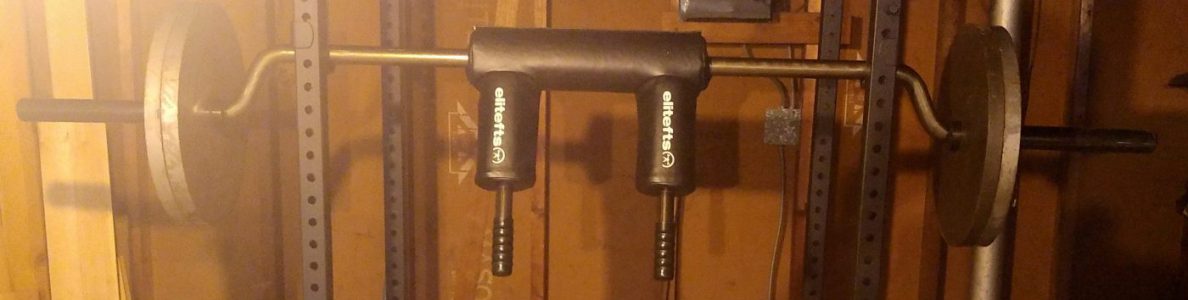
On top of this, to preserve my shoulder integrity, I’ve utilizing the Safety Squat Bar (SSB) from EliteFTS, but because I want to put serious emphasis on my lower body, I’m also performing 1 set of 20 on high bar squats so I don’t lose the basic competitive style squat pattern.
Basic rundown of my program right now is as such:
Weeks 1-4
- Safety Squat Bar Squats – 3×5+
- Close Grip Bench Press – 3×5+
- High Bar Squat – 1×20
- Deadlift – 3×5+
Weeks 5-8
- Safety Squat Bar Squats – 3×5+
- Close Grip Bench Press – 3×5+ / Seated OHP/Behind-the-Neck Press – 3×10+/5
- High Bar Squat – 1×20
- Deadlift – 3×5+
There are a few caveats to make note of:
- Every 3rd set is an AMRAP with a goal minimum of 10 reps
- Weights are increased every workout as long as a minimum of 10 reps are hit on the AMRAP set. If the requisite reps can’t be hit, repeat the same weight for the next workout. If 3 workouts go by without any progress on the lift, deload to 85% of the plateau weight and restart the progression.
- For weeks 5-8, I decided to throw on my knee sleeves – my knees have been taking a beating from the high volume of squatting and as the weights go up, I’m needing additional support and warmth in the joint.
- I’m alternating between the close-grip bench and seated overhead pressing every other workout.
- For seated OHP, I’m doing higher volume as the weights are very low – sets of 10, and then immediately supersetting sets of 5 with behind the neck press.
- Behind the neck press is not to be taken for an AMRAP, and overall, the reps are not important. If I can’t hit the 5 reps, that’s ok, the goal is just additional shoulder volume hitting the whole shoulder capsule.
Now, as you can see, I’m hitting a ton of volume on my lower body and a fairly low amount on upper body. I’ll admit, this is largely my preference and I just enjoy training lower body – I love squatting and I love deadlifting. If I didn’t enjoy competing in powerlifting, I wouldn’t even care about my bench press in any significant manner. That said, I do compete in powerlifting, and as such my upper body is going to need more focus as I move forward.
For now, I’m building my base, and that’s what this 8 week macrocycle is for. In my next posts I’ll be going over the next several stages of my personal programming, and then I will discuss my approach to training others.
 Ramble on Fitness